How to draw a castle that looks defensible
How to draw a castle, in twelve steps, each with its own drawing. The order matters more here than in any other subject in this series: get the silhouette and the battlement spacing right early and the detail looks after itself.
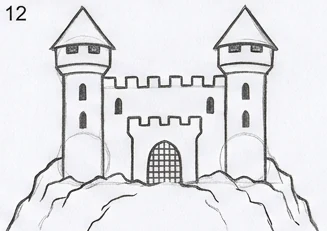
A castle is an easy subject drawn badly and a hard one drawn well, because it is made almost entirely of straight lines and repeated shapes. Both are unforgiving. Wonky verticals and unevenly spaced battlements are the two things that make a castle drawing look amateur, and both are decided in the first four steps.
How to draw a castle: the twelve steps
1. Rough masses first
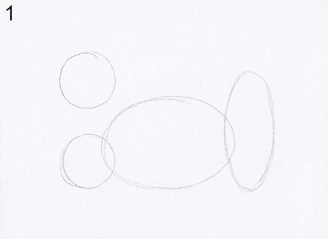
Three or four overlapping circles and ovals where the towers and the keep will sit, and a light horizontal line for the ground. You are deciding the silhouette here, and very little else matters yet: a castle is recognized at a distance by its bumps, so get those spaced before any straight edge appears.
2. Box in the keep
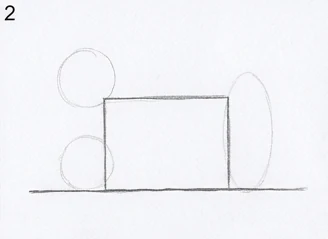
A rectangle for the central block, sitting on the ground line. Keep the sides genuinely vertical — a castle drawn with leaning walls looks like a sandcastle, and it is far harder to correct later than it is to get right now.
3. Towers as cylinders
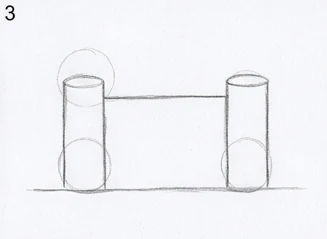
Two vertical tubes rising past the keep, each one a rectangle with a shallow curve at the top and bottom. That curve is what makes them round rather than flat. Make them taller than the keep so the skyline has three heights in it.
4. Crenellate the tops
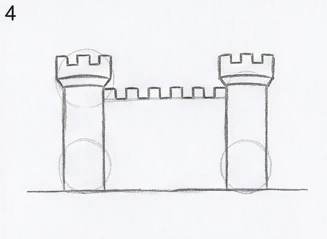
The square teeth along the top of each tower and the wall. Draw the band they sit in first, then divide it, otherwise the gaps drift wider as you work across. Evenly spaced battlements are most of what makes a drawing read as a castle.
5. The gateway
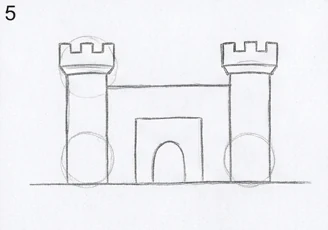
An arch in the center of the wall, roughly twice as tall as it is wide. Put it dead center unless you have a reason not to — castle façades are usually symmetrical, and the eye notices when the door is off.
6. Portcullis and gate detail
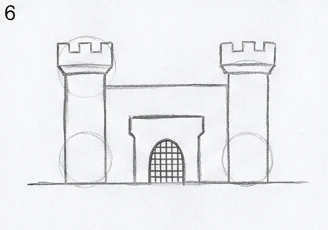
A grid inside the arch, angled slightly to follow the arch curve at the top. Add the heavy stone surround. This is the first piece of detail that tells the viewer the scale of everything else.
7. Windows and arrow slits
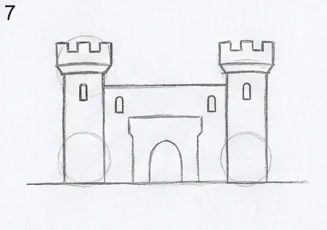
Narrow vertical slits on the towers, a few small windows on the keep. Fewer than you think: castles are mostly wall. Line them up in vertical columns so the building reads as having floors.
8. Stonework where it shows
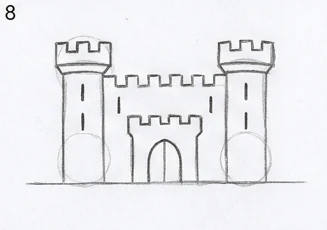
Not everywhere. A few courses of blocks around the arch, along the top edges and at the corners, fading out across the flat faces. Drawing every stone flattens the whole thing into a brick pattern.
9. Roof cones on the towers
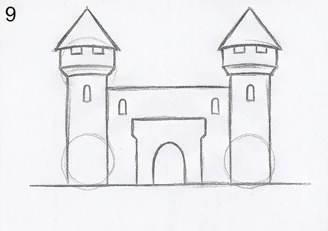
A tall triangle on each tower, oversailing the walls slightly so there is an eave. Steeper than feels right — a shallow cone looks like a tent, and a steep one looks like a castle.
10. Put it on a rock
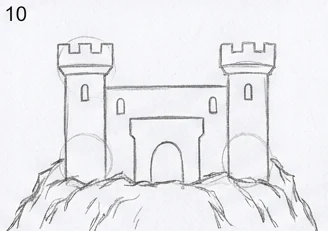
A jagged mass below the ground line, wider than the building and irregular. This is what turns a building into a fortress, and it is the fastest single improvement available in this drawing.
11. Darken the structure
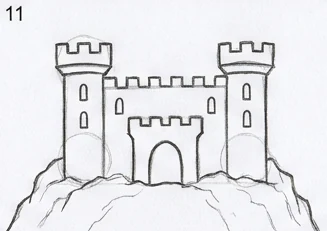
Go over the silhouette, then the battlements, then the openings. Leave the stonework light. The building should read as solid before any shadow goes on it.
12. Shade one side only
Pick a direction for the light and shade the opposite face of every tower, the underside of each eave and the inside of the arch. One direction, applied consistently, does more than any amount of texture.
Why the rock matters so much
Step ten is the one people skip and it does more than any other. A castle sitting on a flat ground line is a building. The same castle on an irregular crag is a fortress, because the rock explains why anybody put it there.
It also solves a compositional problem for free: the jagged base gives the eye something to contrast against all those verticals, and it hides the awkward point where the walls meet the ground.
Draw less stonework than you want to
The instinct is to cover every wall in blocks, and it flattens the drawing every time. Stone courses read as texture, and texture applied evenly across a surface removes the sense that the surface has a form.
Put stonework where a mason would have taken care: around the arch, at the corners, along the top edges. Let it fade out across the middle of each wall and the walls stay solid.
Finished? Print it
Compare the available US sizes and USD product prices before ordering. Shipping is calculated at checkout for your cart and US address; an expedited rate appears when available.
Good to know
What is the easiest way to draw a castle?
Start with rough circles for the tower and keep positions, then box them in. Deciding the silhouette before you draw a single straight line is what stops the drawing going wrong.
How do you draw battlements evenly?
Draw the band they sit in first, then divide it. Drawing the teeth one after another lets the spacing drift wider as you work across, and the drift is very visible.
Why does my castle look flat?
Usually too much stonework spread evenly across the walls, and light coming from no particular direction. Pick one light direction and shade the opposite face of every tower.
Does a castle need to be on a hill?
It does not, but it helps enormously. An irregular rock base turns a building into a fortress and hides the join between the walls and the ground.